SC overdose deaths fell 31.3% in 2024, but Charleston County's improvement came a full year late. New data from the state health department explains the timing gap.
Jump to a section
South Carolina recorded 1,481 drug overdose deaths in 2024, a 31.3% decline from 2,157 deaths the year before. That headline represents the second consecutive annual drop and follows the state's first decrease in overdose fatalities in 11 years. It's the kind of number that appears in a statewide report and signals progress. But the fuller story, and the reason Charleston residents should pay close attention, is far more complicated.

Charleston County's experience with that declining trend tells us something important about how overdose deaths don't fall uniformly across a state. Data from the South Carolina Department of Public Health shows that while the state was beginning its turnaround in 2023, Charleston County was moving in the opposite direction. A full year after South Carolina recorded its first statewide decline in over a decade, Charleston County finally joined the downward trend in 2024.
The State's Turning Point—And Charleston's Delay
In 2023, South Carolina recorded the pivotal moment: its first decline in overdose deaths in 11 years. It wasn't dramatic, a small dip in a long, rising curve, but it was the inflection point the state had been waiting for. Statewide, that decline continued into 2024, accelerating to a 31.3% drop.
Charleston County, however, wasn't part of that 2023 story. It was one of 15 South Carolina counties where overdose deaths actually increased that year, even as the state overall moved downward. When 2024 data arrived, Charleston County finally showed improvement: approximately 153 drug-related deaths, representing a 19% decrease from 2023's toll. That's real progress, but it arrived on a delayed schedule.
This one-year lag matters because it means Charleston residents spent an additional year at elevated risk while the statewide intervention efforts, policy shifts, and harm-reduction initiatives that contributed to the state's 2023 turnaround were already taking root elsewhere. For a county with a drug overdose mortality rate of 37.6 per 100,000 residents, according to the County Health Rankings 2025, that timing gap represents lives that could have been saved sooner.
Fentanyl's Dominance and Uneven Decline
One critical thread connects most 2024 overdose deaths: fentanyl. Of South Carolina's 1,481 deaths last year, 914, or 61.7%, involved fentanyl or fentanyl analogs. That synthetic opioid's proliferation is not evenly distributed across the state. Urban markets with higher drug trafficking volumes, like Charleston's, typically see higher fentanyl concentrations in the drug supply earlier and more intensely than rural areas. This concentration may partly explain why Charleston lagged the state decline, though available data doesn't confirm causation.
Five South Carolina counties did achieve what Charleston has not yet reached: declines of 50% or greater in 2024. Aiken, Colleton, Georgetown, Jasper, and Spartanburg all recorded steep drops. That distribution suggests the mechanisms driving statewide decline, better access to medication-assisted treatment, expanded harm reduction services, and improved emergency response, took hold unevenly, and some regions found faster footing than others.
Why the Lag? An Honest Open Question
The most direct answer to why Charleston County missed the 2023 turnaround is also the most unsatisfying: we don't fully know. Public health data tells us what happened, not always why. Several plausible contributing factors deserve mention, none of them definitive.
Charleston is an urban center with higher population density and a larger, more complex drug market than many South Carolina counties. Urban overdose epidemics often follow different trajectories than rural ones; they're shaped by supply routes, trafficking networks, and the speed at which new substances infiltrate the market.
Service access and awareness lags are also real. Even when evidence-based treatments and harm-reduction programs exist statewide, their reach in high-volume urban markets sometimes falls behind the pace of crisis. It's also possible some of the policy interventions that drove the 2023 statewide decline implemented unevenly or encountered local adoption delays in Charleston's particular configuration of healthcare systems, law enforcement priorities, and community response.
What we can say with certainty is this: Charleston County is not alone in delayed improvement, and the lag does not reflect failure so much as the uneven geography of epidemiological change. But for the people living in Charleston in 2023 and early 2024, that gap was costly.
What This Means Now
The 2024 data shows Charleston County finally moving in the right direction. A 19% annual decline is substantial and signals that whatever barriers slowed the county in 2023 are beginning to yield. But the absolute rate, 37.6 deaths per 100,000 residents, remains elevated compared to many parts of the state.
If you or someone you know is struggling with opioid addiction in Charleston, the availability of evidence-based care, medication-assisted treatment, counseling, peer support, and long-term recovery services, is no longer a given. Lantana Recovery's Charleston, SC location offers comprehensive outpatient addiction treatment for adults, grounded in the same evidence-based approaches that have driven the statewide improvement now reaching the county.
South Carolina's 31% overdose decline in 2024 is real. Charleston County's delayed entry into that progress is a reminder that statewide headlines often mask regional variation, and that the people living through that lag experience it as a year of elevated risk, not as a footnote to a larger trend.

Sources
- South Carolina Department of Public Health — 2024 Drug Overdose Deaths Report, published July 2026https://dph.sc.gov/news/dph-reports-continued-decline-overdose-deaths
- County Health Rankings — Charleston County, South Carolinahttps://www.countyhealthrankings.org/health-data/south-carolina/charleston
Reviewed by
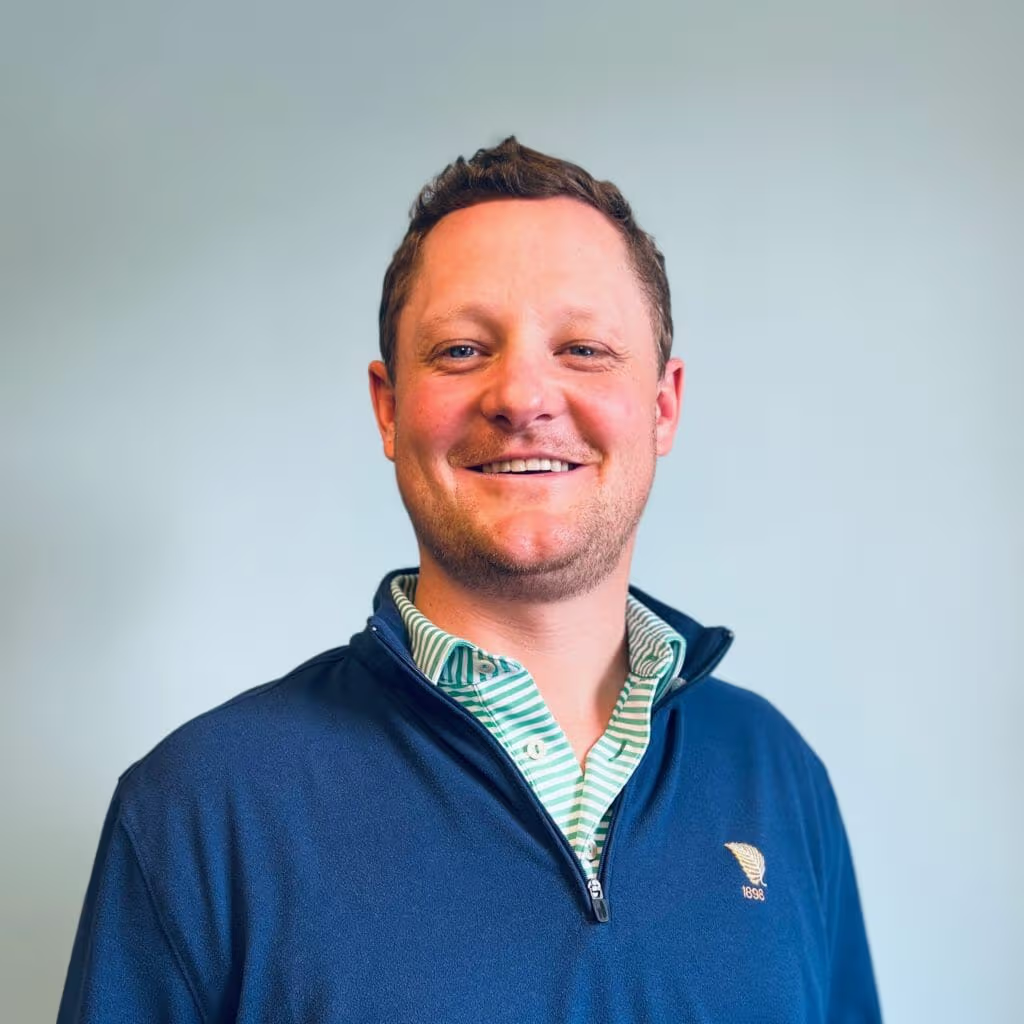
Warren PhillipsCo-Founder, LMSW · Editorial Reviewer
Warren Phillips is a Co-Founder of Lantana Recovery and a Licensed Master Social Worker (LMSW) specializing in substance abuse and mental health treatment. He previously worked in various capacities at Turnbridge Addiction Treatment and Clearpoint Recovery Center before co-founding Lantana Recovery. Warren's clinical approach draws on a strengths-based perspective, Twelve Step philosophies, Cognitive Behavioral Therapy, and Motivational Interviewing. He brings both personal and professional experience to his work — as a person in long-term recovery from alcohol and illicit substances, he has used that experience to help shape Lantana's treatment programming. Warren grew up in Memphis, TN and St. Louis, MO, attended college in Mississippi, and lived in California and Connecticut before relocating to Charleston. He now lives in Mount Pleasant with his wife, Angela, and their two young children, Hall and Sam.
Written by the Lantana Recovery Editorial Team and reviewed for clinical accuracy before publication.