Where South Carolina's detox, residential, PHP, IOP, and outpatient addiction care actually breaks down by region — and why it matters.
Jump to a section
Addiction treatment works best as a continuum — detox, then residential or partial hospitalization, then intensive outpatient, then standard outpatient, with intensity stepping down as stability builds. In practice, every level of that continuum is not available in every South Carolina county, and the gap between what a treatment plan calls for and what is actually reachable is a real access barrier, not a theoretical one.
Key Takeaways on SC Treatment Availability
- South Carolina's addiction-treatment infrastructure is concentrated in and around its metro counties (Charleston, Richland/Columbia, Greenville), leaving large rural stretches of the state reliant on driving distance or telehealth for structured levels of care.
- Detox and residential beds are the scarcest resource statewide — SAMHSA's national FindTreatment.gov directory shows far fewer inpatient/residential listings than outpatient listings for most SC counties.
- PHP (partial hospitalization) and IOP (intensive outpatient) — the "step-down" levels between residential and standard outpatient — are the levels most often missing entirely in rural counties, forcing a jump straight from residential back to weekly outpatient.
- Opioid use disorder rates in the Charleston Tri-County area run close to 2.5 per 1,000 population for women (SC DHHS, 2022), yet medication-assisted treatment (MAT) providers are not evenly distributed to match that need.
- South Carolina's overdose deaths fell 31.3% from 2023 to 2024 (2,157 to 1,481, per SC DPH), progress that treatment-access gaps could undercut if step-down care isn't reachable after an overdose event.
What "Continuum of Care" Actually Means
A functioning continuum has five typical stops: medically supervised detox to manage withdrawal safely, residential treatment for 24-hour structured care, partial hospitalization (PHP) for a high-intensity day-program step-down, intensive outpatient (IOP) for several hours a week of group and individual work, and standard outpatient care for ongoing maintenance. The clinical logic depends on being able to move a patient down that ladder as they stabilize — skipping a rung because the next level isn't available nearby is where relapse risk rises.
Where the Gaps Actually Are
SAMHSA's FindTreatment.gov directory — the federal government's own treatment-locator tool — lets a search be filtered by service type and county. Run that search across South Carolina's coastal and Lowcountry counties and a consistent pattern shows up: outpatient counseling listings are common in nearly every county, but residential, detox, and PHP/IOP listings cluster heavily around Charleston, Columbia, Greenville, and Myrtle Beach. Counties outside those metro areas frequently show zero or one residential facility, meaning anyone in that county who needs inpatient-level care is, by definition, leaving the county to get it.
This unevenness tracks with South Carolina's general behavioral-health workforce shortage: large portions of the state carry federal Health Professional Shortage Area (HPSA) designations for mental health, which overlaps heavily with addiction-treatment capacity since many providers and facilities serve both populations. A shortage designation for prescribers and clinicians translates directly into fewer PHP/IOP program slots, since those levels of care require daily or near-daily licensed clinical staffing.
The PHP/IOP Gap Specifically
PHP and IOP are the levels most likely to be missing in a rural or outreach-office county, for a structural reason: they require a physical program location that a patient attends multiple days a week, unlike standard outpatient (which can run on a lighter weekly schedule) or residential (which houses the patient on-site). A county without a population base to fill a daily program simply doesn't get one. The practical result for a patient discharging from residential treatment in a smaller SC county is often a choice between commuting a significant distance to a PHP/IOP program in a metro county, or stepping straight down to standard outpatient — a bigger drop in support than is clinically ideal right after residential discharge.
Medication-Assisted Treatment Availability
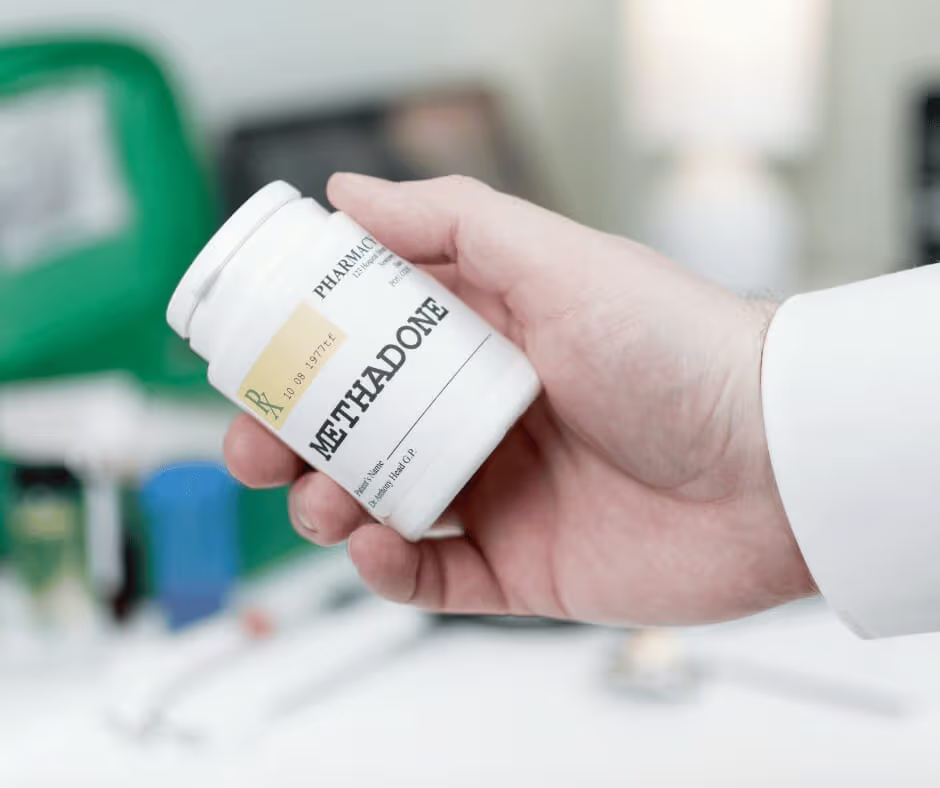
Medication-assisted treatment (MAT) for opioid use disorder — buprenorphine, naltrexone, or methadone paired with counseling — is the evidence-based standard for opioid use disorder, and the Tri-County area's opioid use disorder rate (2.0–2.5 per 1,000 population depending on county and sex, per SC DHHS 2022 data) points to real demand for it. MAT prescribing authority requires specific provider training and, for methadone, a licensed opioid treatment program — both of which are unevenly distributed relative to that demand, consistent with the same workforce-shortage pattern seen across PHP/IOP capacity.
What This Means for Families Building a Treatment Plan
The practical takeaway is not that a gap-county has no options — it's that a treatment plan built without checking regional service availability first can specify a level of care the patient's county simply cannot deliver. Confirming which levels of care are actually staffed and available before committing to a facility avoids that mismatch. Lantana Recovery's Charleston, Columbia, and Murrells Inlet locations cover the state's higher-capacity metro corridor, which is exactly where the fuller continuum — detox through IOP — is more consistently reachable.
FAQ: South Carolina Treatment Access
Which level of addiction care is hardest to find in South Carolina?
Why are treatment services concentrated in certain SC counties?
How can I check what treatment levels are actually available near me?
Does South Carolina have enough medication-assisted treatment providers?
Bottom Line
South Carolina's addiction-treatment continuum is real but geographically uneven — outpatient counseling is broadly available, while detox, residential, and especially PHP/IOP step-down programs concentrate around a handful of metro counties. Confirming which levels of care a facility actually staffs, before treatment starts, is the single best way to avoid a plan that looks complete on paper but has a gap the patient's home county can't fill.
Sources
- SAMHSA — FindTreatment.gov (national treatment services locator)https://findtreatment.gov/
- SC DPH — Behavioral Health: Berkeley, Charleston, and Dorchester Counties Drug Use (Tri-County report)https://dph.sc.gov/sites/scdph/files/2025-04/DW_Drug_Use_2024_Tri-County.pdf
- Rural Health Information Hub — Mental Health Care Health Professional Shortage Areas by countyhttps://www.ruralhealthinfo.org/charts/7
Reviewed by
Warren PhillipsCo-Founder, LMSW · Editorial Reviewer
Warren Phillips is a Co-Founder of Lantana Recovery and a Licensed Master Social Worker (LMSW) specializing in substance abuse and mental health treatment. He previously worked in various capacities at Turnbridge Addiction Treatment and Clearpoint Recovery Center before co-founding Lantana Recovery. Warren's clinical approach draws on a strengths-based perspective, Twelve Step philosophies, Cognitive Behavioral Therapy, and Motivational Interviewing. He brings both personal and professional experience to his work — as a person in long-term recovery from alcohol and illicit substances, he has used that experience to help shape Lantana's treatment programming. Warren grew up in Memphis, TN and St. Louis, MO, attended college in Mississippi, and lived in California and Connecticut before relocating to Charleston. He now lives in Mount Pleasant with his wife, Angela, and their two young children, Hall and Sam.
Written by the Lantana Recovery Editorial Team and reviewed for clinical accuracy before publication.