SAMHSA 2023 data reveals South Carolina's addiction treatment gap and how Medicaid non-expansion is blocking access for hundreds of thousands.
Jump to a section
In 2023, according to the most recent data from the SAMHSA National Surveys on Drug Use and Health, 840,000 South Carolinians aged 12 and older (18.60% of the population) were classified as needing substance use disorder treatment. Of those, only 203,000 people (4.51%) actually received it. That means 643,000 South Carolinians needed help and did not get it. That's 76 percent of everyone who needed care.
This gap is not a result of lack of need. It is a result of barriers that, while complicated, are partly within reach to fix.
Key Takeaways
- 643,000 South Carolinians who needed addiction treatment in 2023 did not receive it
- Young adults ages 18-25 face the highest unmet need: 82.75% of those needing treatment got no care
- South Carolina's decision not to expand Medicaid leaves an estimated 105,000 adults in a coverage gap, blocking access for those who cannot pay out of pocket
- More than one in six South Carolinians (761,000 people) had a substance use disorder in the past year
- Treatment works. The problem is not that it doesn't help; it is that most people who need it cannot access it

Breaking Down the Numbers
The unmet need in South Carolina spans all age groups, but it is most severe among young adults. Among ages 18 to 25, 82.75% of those needing treatment received none. Among teenagers ages 12 to 17, the unmet rate is 56.56%, still well above half.
The data also shows which substances are most prevalent. Alcohol use disorder affects 455,000 South Carolinians (10.09% of the population). Opioid use disorder affects 106,000 (2.35%). The overall substance use disorder rate of 16.86% represents 761,000 people. These are not marginal populations; they are one in every six neighbors.
When the data is broken down this way, one reality becomes clear: this is not a rare problem affecting a small number of people with particularly severe addiction. This is a widespread public health crisis touching hundreds of thousands of families, and the treatment system is not designed to meet the scale of need.
Why the Gap Exists: The Medicaid Question
Many of the people who need treatment but do not receive it have no way to pay for care. This is where policy enters the story.
South Carolina has not expanded Medicaid under the Affordable Care Act. As a result, non-disabled childless adults are broadly ineligible for South Carolina Medicaid regardless of income. No insurance means no coverage for treatment. Researchers estimate this coverage gap affects approximately 105,000 South Carolinians who would be eligible for Medicaid in an expansion state but are locked out in South Carolina.
The Medicaid non-expansion is not the only barrier to treatment. Some people have insurance but do not know treatment is available. Others are geographically isolated from treatment centers. Still others face stigma or fear. But the inability to pay for treatment is a primary reason why people in need do not access it, and Medicaid non-expansion is a concrete policy choice that widens that barrier.
Bills proposing Medicaid expansion in South Carolina, including H.3109, have stalled in the legislative session. The human cost of that inaction is visible in these numbers: hundreds of thousands of people without access to care.
What to Do If You or Someone You Know Needs Treatment
If you think you may have a substance use disorder, or if someone you care about does, help is available. A critical first step is to understand your insurance coverage. Verifying whether treatment is covered under your plan is free and takes minutes, and it often opens doors that feel closed.
If you live in South Carolina, our Charleston, SC treatment center offers outpatient addiction and SUD treatment for adults in the region. If you are in Connecticut, our New Milford location serves patients there as well. Both programs accept most insurance plans and work with patients on coverage questions.
You can also contact SAMHSA's National Helpline at 1-800-662-4357, a free and confidential service available 24/7 that can connect you to local treatment resources, regardless of whether you have insurance.
The Path Forward
These numbers are sobering. But they are not inevitable. Treatment for substance use disorder has strong evidence behind it. The problem is not that treatment does not work; it is that access to treatment is not built into the system in a way that reaches everyone who needs it. Until South Carolina addresses barriers like insurance coverage, these statistics will not change.
Sources
- SAMHSA, 2022–2023 National Surveys on Drug Use and Health, South Carolina state estimates (Table 92B)https://www.samhsa.gov/data/sites/default/files/reports/rpt56188/2023-nsduh-sae-state-tables_0/2023-nsduh-sae-state-tabs-south-carolina.pdf
Reviewed by
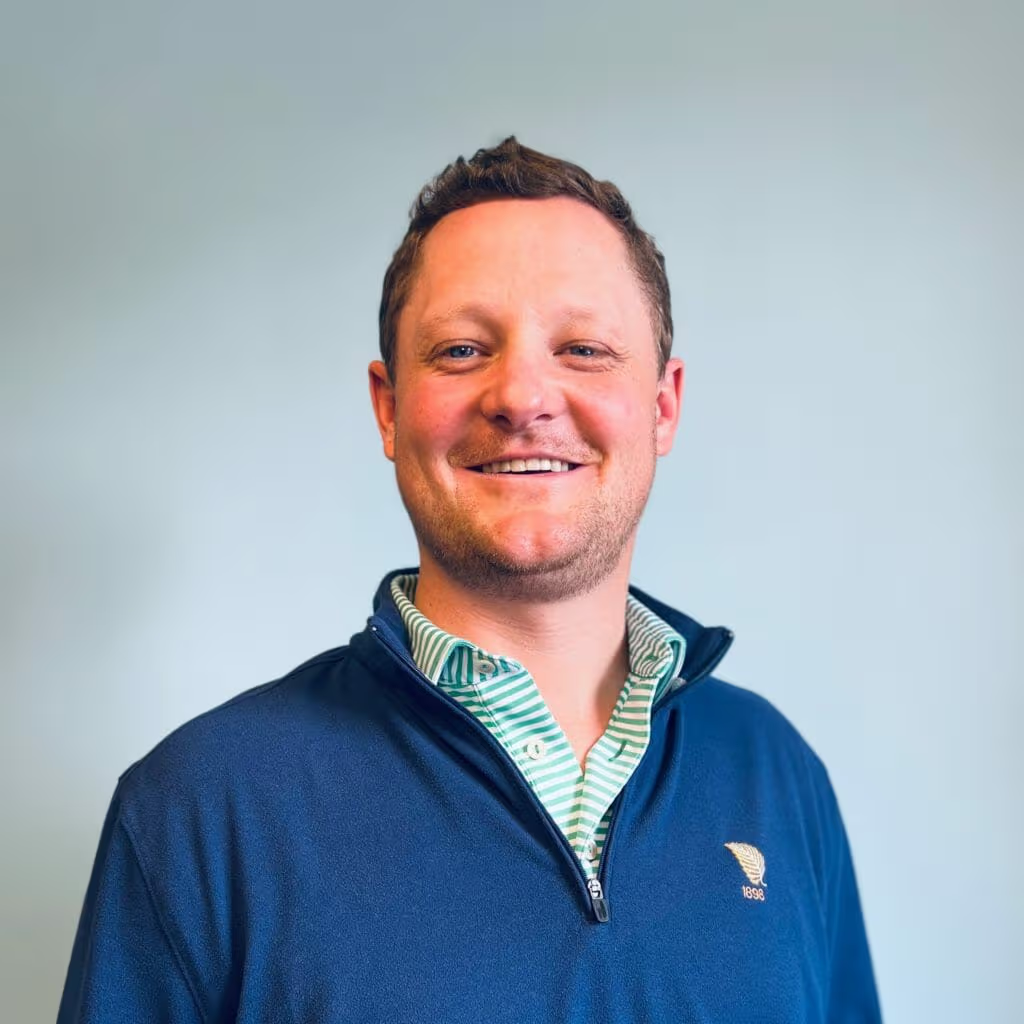
Warren PhillipsCo-Founder, LMSW · Editorial Reviewer
Warren Phillips is a Co-Founder of Lantana Recovery and a Licensed Master Social Worker (LMSW) specializing in substance abuse and mental health treatment. He previously worked in various capacities at Turnbridge Addiction Treatment and Clearpoint Recovery Center before co-founding Lantana Recovery. Warren's clinical approach draws on a strengths-based perspective, Twelve Step philosophies, Cognitive Behavioral Therapy, and Motivational Interviewing. He brings both personal and professional experience to his work — as a person in long-term recovery from alcohol and illicit substances, he has used that experience to help shape Lantana's treatment programming. Warren grew up in Memphis, TN and St. Louis, MO, attended college in Mississippi, and lived in California and Connecticut before relocating to Charleston. He now lives in Mount Pleasant with his wife, Angela, and their two young children, Hall and Sam.
Written by the Lantana Recovery Editorial Team and reviewed for clinical accuracy before publication.