How far Lowcountry residents travel for addiction treatment, why distance is a real barrier, and where Charleston-area treatment capacity concentrates.
Jump to a section
Getting into addiction treatment isn't only about whether a program exists — it's about whether someone in active crisis, without reliable transportation, can actually reach it. For the Charleston Lowcountry, that distance question has a real answer, and it varies a lot depending on which part of the Tri-County area — or the outreach counties beyond it — someone lives in.
Key Takeaways on Lowcountry Treatment Access
- Addiction-treatment capacity in the Lowcountry concentrates around the Charleston peninsula and North Charleston, meaning outlying parts of Berkeley and Dorchester counties, plus outreach areas further out, involve real driving distance to reach a program.
- Charleston County's naloxone administration rate (3.3 per 1,000 population) is the highest of the three Tri-County counties, per SC DPH data — a sign of concentrated overdose-response activity in the county with the most treatment infrastructure, not necessarily the most underlying need.
- SAMHSA's FindTreatment.gov shows fewer residential and detox listings than outpatient listings across most of the Lowcountry outside metro Charleston, meaning higher-intensity care often requires the longest drives.
- Lack of transportation is one of the most commonly cited practical barriers to substance use treatment nationally, alongside cost and lack of available appointments, per SAMHSA's National Survey on Drug Use and Health treatment-gap data.
- South Carolina's 31.3% statewide drop in overdose deaths from 2023 to 2024 shows progress is possible — but progress concentrated where treatment access is easiest doesn't automatically reach outlying Lowcountry communities.
Why Distance to Treatment Is a Real Access Barrier
Addiction treatment, especially at the residential, PHP, and IOP levels, typically requires either living on-site or attending a program location multiple days a week for weeks or months. For someone without reliable transportation — a common reality during active addiction, when jobs, driver's licenses, and vehicles are often among the first things lost — a 30-45 minute drive each way, several days a week, is not a minor inconvenience. It's frequently the difference between completing a program and dropping out, or between starting treatment at all and not starting. SAMHSA's national treatment-gap surveys consistently list transportation alongside cost and appointment availability as one of the most common reasons people who need substance use treatment don't get it.
Where Lowcountry Treatment Capacity Actually Sits
Using SAMHSA's FindTreatment.gov locator — the federal government's own directory of licensed treatment providers, searchable by county and level of care — the Lowcountry's addiction-treatment infrastructure clusters around the Charleston peninsula, West Ashley, and North Charleston. Outpatient counseling options extend further out into Berkeley and Dorchester counties, but residential and detox capacity is concentrated much more tightly. For residents of outlying Berkeley County communities, or Dorchester County beyond Summerville, reaching a residential or PHP-level program in Charleston proper is a genuine commute, not a short trip — and that's before accounting for further-out outreach communities like Murrells Inlet or Columbia, which route their own residents toward Charleston or other metro treatment hubs for higher levels of care.
What the Naloxone Data Suggests About Access, Not Just Overdoses
Charleston County's EMS naloxone administration rate (3.3 per 1,000 population) is higher than Berkeley's (1.8) and Dorchester's (1.1), per SC DPH's Tri-County report. Read alongside where treatment infrastructure actually sits, this pattern is consistent with — though doesn't prove on its own — a dynamic where the county with the most EMS and treatment infrastructure also shows the most documented overdose-response activity, while outlying counties may have overdose events that go less consistently captured or responded to with the same EMS density. It's a reminder that "where the data is highest" and "where the need is highest" aren't automatically the same county.
What Reduces the Distance Problem in Practice
A few things narrow the access gap: standard outpatient and telehealth-delivered counseling need less frequent in-person attendance than residential or PHP care, making them more reachable for someone with limited transportation. Family or community support for transportation during the highest-intensity early weeks of treatment measurably improves completion odds. And choosing a facility that's realistic about the actual commute — rather than the nearest option on paper that turns out to be an hour away in practice — avoids setting up a treatment plan that can't be sustained.
How This Plays Out for Charleston, Columbia, and Murrells Inlet
Lantana Recovery operates in Charleston, SC, with outreach into Columbia and Murrells Inlet — a structure built around the reality that residents across the wider region often travel to Charleston for higher levels of care like residential treatment or PHP, then can step down to more locally reachable IOP or outpatient support as recovery stabilizes.
FAQ: Getting to Treatment in the Lowcountry
Is transportation a real barrier to addiction treatment?
Where is most addiction-treatment capacity located in the Charleston area?
Does a higher naloxone administration rate mean a county has more overdoses?
What can reduce the distance barrier to getting treatment?
Bottom Line
Distance to care is a quiet but real barrier across the Lowcountry, shaped by where treatment infrastructure has concentrated rather than where need is evenly spread. Understanding that pattern — and building a treatment plan around realistic travel, with a clear step-down path to more locally reachable care — is part of making a plan that actually holds up.
Sources
- SC DPH — Behavioral Health: Berkeley, Charleston, and Dorchester Counties Drug Use (Tri-County report)https://dph.sc.gov/sites/scdph/files/2025-04/DW_Drug_Use_2024_Tri-County.pdf
- SAMHSA — FindTreatment.gov (national treatment services locator)https://findtreatment.gov/
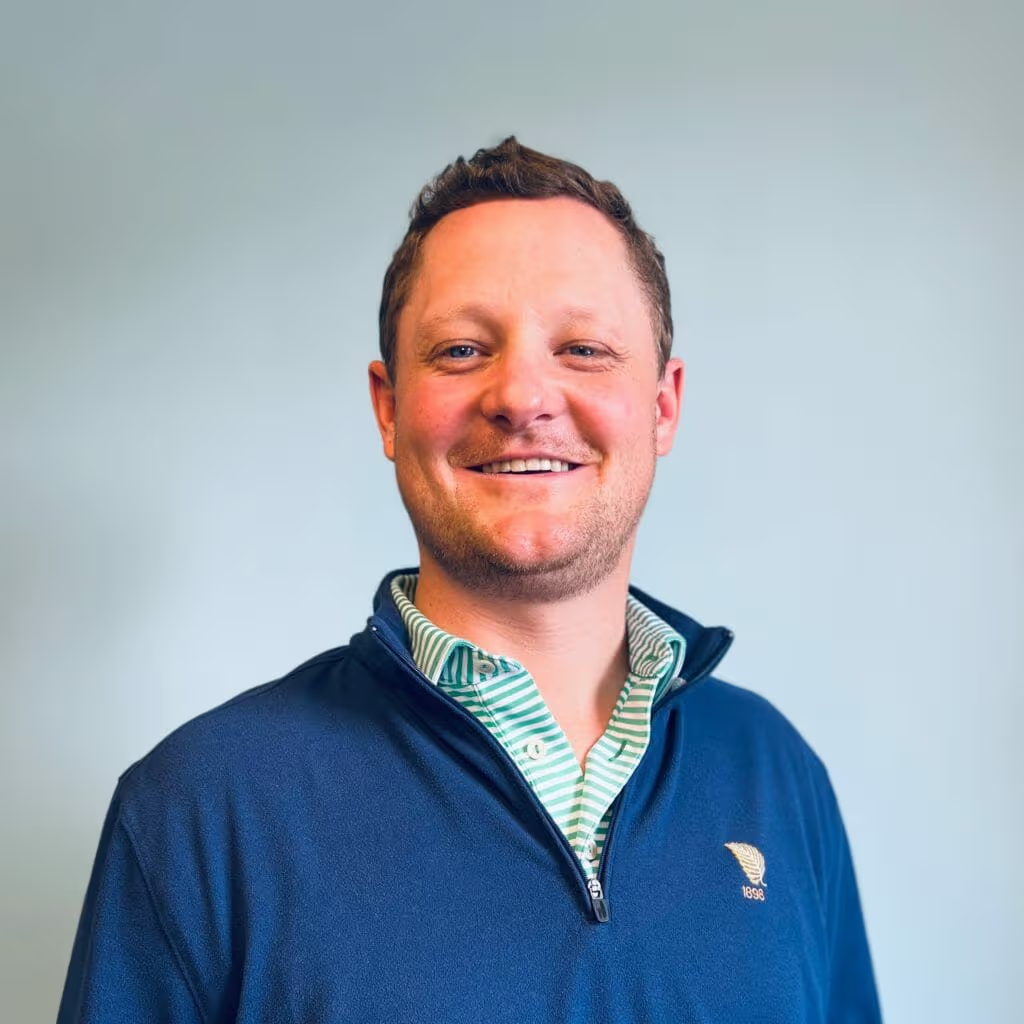
Reviewed by
Warren PhillipsCo-Founder, LMSW · Editorial Reviewer
Warren Phillips is a Co-Founder of Lantana Recovery and a Licensed Master Social Worker (LMSW) specializing in substance abuse and mental health treatment. He previously worked in various capacities at Turnbridge Addiction Treatment and Clearpoint Recovery Center before co-founding Lantana Recovery. Warren's clinical approach draws on a strengths-based perspective, Twelve Step philosophies, Cognitive Behavioral Therapy, and Motivational Interviewing. He brings both personal and professional experience to his work — as a person in long-term recovery from alcohol and illicit substances, he has used that experience to help shape Lantana's treatment programming. Warren grew up in Memphis, TN and St. Louis, MO, attended college in Mississippi, and lived in California and Connecticut before relocating to Charleston. He now lives in Mount Pleasant with his wife, Angela, and their two young children, Hall and Sam.
Written by the Lantana Recovery Editorial Team and reviewed for clinical accuracy before publication.