New data reveals rural Litchfield County has 14.9 psychiatrists per 100k vs 78 in urban CT. Learn how telehealth buprenorphine is expanding access.
Jump to a section
In January 2025, researchers at the WWAMI Rural Health Research Center published a stark finding: Northwest Hills, the rural planning region that includes Litchfield County and Lantana Recovery's New Milford location, has just 14.9 psychiatrists per 100,000 population. In South Central Connecticut, that number is 78.0 per 100,000. That is a gap of 5.2 times in one of the nation's smallest states.
Key Takeaways
- Northwest Hills (rural Litchfield County) has 14.9 psychiatrists per 100,000 population, compared to 78.0 in South Central CT, a 5.2-fold gap.
- Across Connecticut, rural counties have 10.9 psychiatrists per 100,000 versus 36.8 in urban counties, a 3.4-fold gap statewide.
- Connecticut's own government has formally identified lack of transportation to mental health services as a regional barrier in rural Litchfield County.
- The DEA's January 2025 final rule now allows buprenorphine initiation via telehealth (including audio-only calls) for up to six months without an in-person exam.

The Full Picture: Behavioral Health Workforce Distribution
The Woolcock study measured not just psychiatrists but the entire behavioral health workforce across Connecticut (per 100,000 population): Northwest Hills has 14.9 psychiatrists, 18.4 psychologists, 22.8 psychiatric NPs, 141.1 counselors, 214.7 social workers. Western CT has 34.7 psychiatrists, 56.4 psychologists, 13.3 psychiatric NPs, 157.1 counselors, 206.3 social workers. South Central CT has 78.0 psychiatrists, 81.7 psychologists, 31.2 psychiatric NPs, 196.8 counselors, 285.8 social workers. Statewide Connecticut averages 35.3 psychiatrists, 50.6 psychologists, 22.9 psychiatric NPs, 206.0 counselors, 238.6 social workers.
The psychiatrist shortage stands out. Counselors and social workers, while unevenly distributed, exist in reasonable density across rural regions. But psychiatrists and psychologists cluster in cities.
The Problem Connecticut Has Officially Documented
Connecticut's DMHAS, working with the Western CT Coalition, published a Regional Priority Report for Region 5 explicitly naming a key access barrier: lack of public transportation to mental health and addiction services.
For addiction treatment specifically, this barrier is critical. Substance use disorder often co-occurs with depression, anxiety, trauma, and other psychiatric conditions. A patient who cannot easily reach a psychiatrist is a patient whose recovery plan may be incomplete.
A Concrete Tool: DEA's 2025 Telehealth Rule for Buprenorphine
In January 2025, the DEA issued a final rule permanently allowing providers to initiate buprenorphine treatment via telehealth, including audio-only phone calls, for up to the first six months without requiring an in-person examination.
For a patient in rural Litchfield County, this means they can call a treatment provider, have an initial assessment via secure video or phone, and begin medication-assisted treatment without driving an hour to an urban clinic first.
Getting Connected: What Rural Patients Should Know
If you or someone you care about is struggling with substance use in rural Connecticut, two things are true. First: yes, your area has fewer psychiatrists and specialists than urban regions. Second: treatment is still available, and new tools like telehealth buprenorphine initiation have made it more accessible.
Our New Milford, CT treatment center serves patients across the wider region, including those in Litchfield County and beyond. We work with telehealth-enabled medication-assisted treatment, integrated psychiatric and counseling support, and partnerships with specialists when in-person care is needed.
Sources
- Woolcock SC, Andrilla CHA, Garberson LA, Graves JM. The Supply and Rural-Urban Distribution of the Behavioral Health Workforce in Connecticut. WWAMI Rural Health Research Center, October 2025https://familymedicine.uw.edu/rhrc/wp-content/uploads/sites/4/2025/10/RHRC_DBOCT2025_CT_BH_Woolcock.pdf
- Connecticut DMHAS / Western CT Coalition — 2024-25 Regional Priority Report: Region 5https://portal.ct.gov/-/media/dmhas/publications/region-5-priority-report_final.pdf
Reviewed by
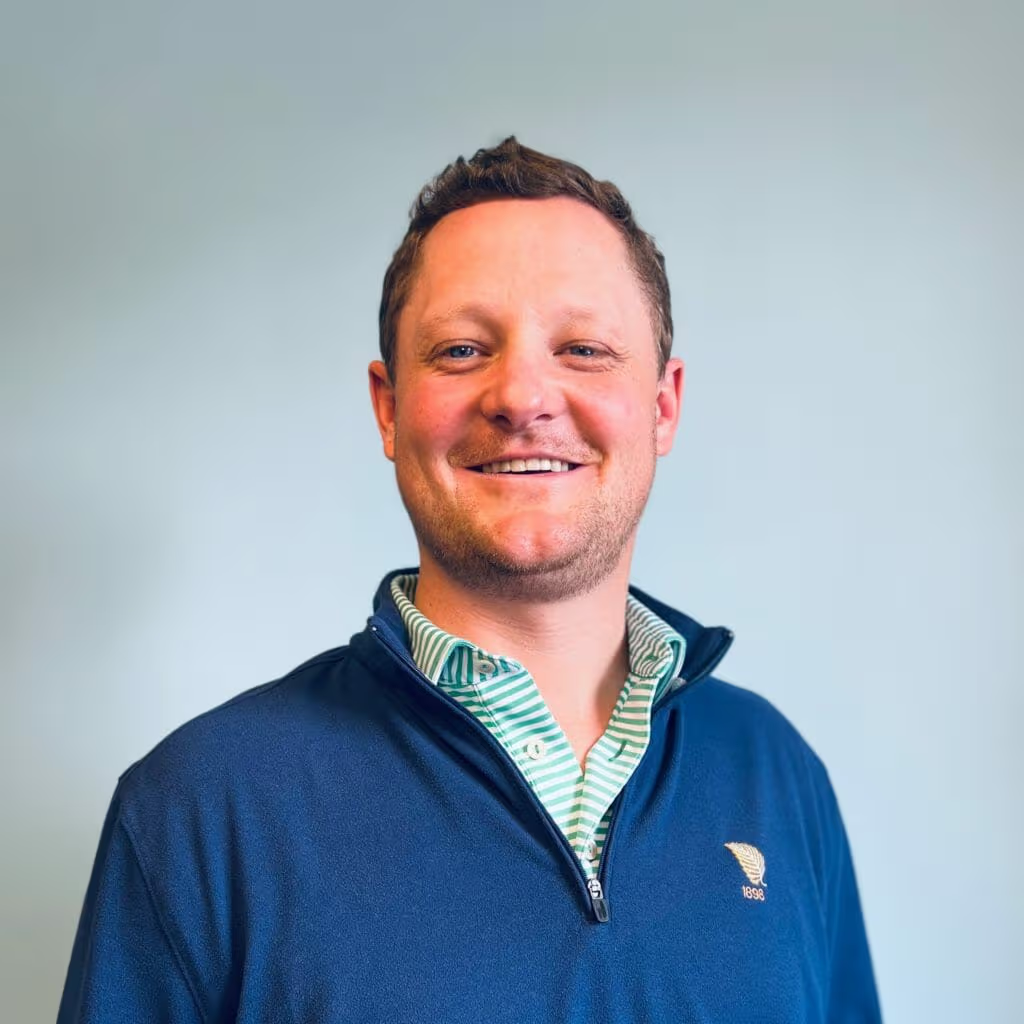
Warren PhillipsCo-Founder, LMSW · Editorial Reviewer
Warren Phillips is a Co-Founder of Lantana Recovery and a Licensed Master Social Worker (LMSW) specializing in substance abuse and mental health treatment. He previously worked in various capacities at Turnbridge Addiction Treatment and Clearpoint Recovery Center before co-founding Lantana Recovery. Warren's clinical approach draws on a strengths-based perspective, Twelve Step philosophies, Cognitive Behavioral Therapy, and Motivational Interviewing. He brings both personal and professional experience to his work — as a person in long-term recovery from alcohol and illicit substances, he has used that experience to help shape Lantana's treatment programming. Warren grew up in Memphis, TN and St. Louis, MO, attended college in Mississippi, and lived in California and Connecticut before relocating to Charleston. He now lives in Mount Pleasant with his wife, Angela, and their two young children, Hall and Sam.
Written by the Lantana Recovery Editorial Team and reviewed for clinical accuracy before publication.