Nicotine's half-life is about 2 hours, but tests measure cotinine, whose 16-hour half-life reflects the past 3 to 4 days of use.
Jump to a section
How long nicotine stays in your system has two answers, because nicotine and the thing tests actually look for are different molecules. Nicotine itself has a plasma half-life of about two hours. Cotinine, the metabolite nearly every nicotine test measures, has a half-life of about 16 hours and reflects use over the past several days. This article covers both timelines, what each type of test detects, what speeds clearance up or slows it down, and why a vape, a pouch, and a cigarette all look identical on a lab result.
Key Takeaways on How Long Nicotine Lasts
- Nicotine's plasma half-life averages about 2 hours, so nicotine itself is largely cleared within roughly 10 to 12 hours of the last use.
- Between 70% and 80% of nicotine is converted to cotinine, which has a half-life of about 16 hours — which is why tests measure cotinine, not nicotine.
- Blood cotinine reflects exposure over the past 3 to 4 days. Hair and nail analysis covers months.
- The liver enzyme CYP2A6 sets the pace, and its activity varies enough between people that two smokers of identical habits can clear at measurably different rates.
- Cotinine is a metabolite of nicotine from any source. A test cannot tell a cigarette from a vape, a pouch, or a nicotine patch.
How long does nicotine itself stay in your body?
Nicotine is an alkaloid stimulant, and it leaves the blood quickly. Benowitz and colleagues, in the standard reference on nicotine pharmacokinetics, put the plasma half-life after intravenous infusion or cigarette smoking at about two hours. A half-life is the time to clear half of what is present, so after about five half-lives — roughly 10 to 12 hours — the original amount is down to a few percent.
That is the short answer people usually want, and it is also why it is nearly useless for testing. Someone who last smoked yesterday morning has almost no nicotine left in their blood today. If nicotine were what labs measured, most smokers would test negative most of the time.
One complication: at low concentrations, nicotine shows a longer terminal half-life of around 11 hours, as the drug slowly comes back out of tissue. It does not change the practical picture, but it is why "gone in 10 hours" is a rule of thumb rather than a hard number.
Why do nicotine tests actually look for cotinine?
Cotinine is the major metabolite of nicotine. Roughly 70% to 80% of the nicotine a person takes in is converted to it, in a two-step process in the liver. It stays around far longer than nicotine does, with an average half-life of about 16 hours, and it is specific to nicotine exposure — nothing else in an ordinary diet produces it.
Those three properties are exactly what a biomarker needs: abundant, long-lived, and specific. That is why an insurance physical, a pre-employment screen, or a research study measures cotinine and calls it a nicotine test. The distinction matters practically: quitting 12 hours before a test clears most of the nicotine and almost none of the cotinine.
How long is nicotine detectable on each type of test?
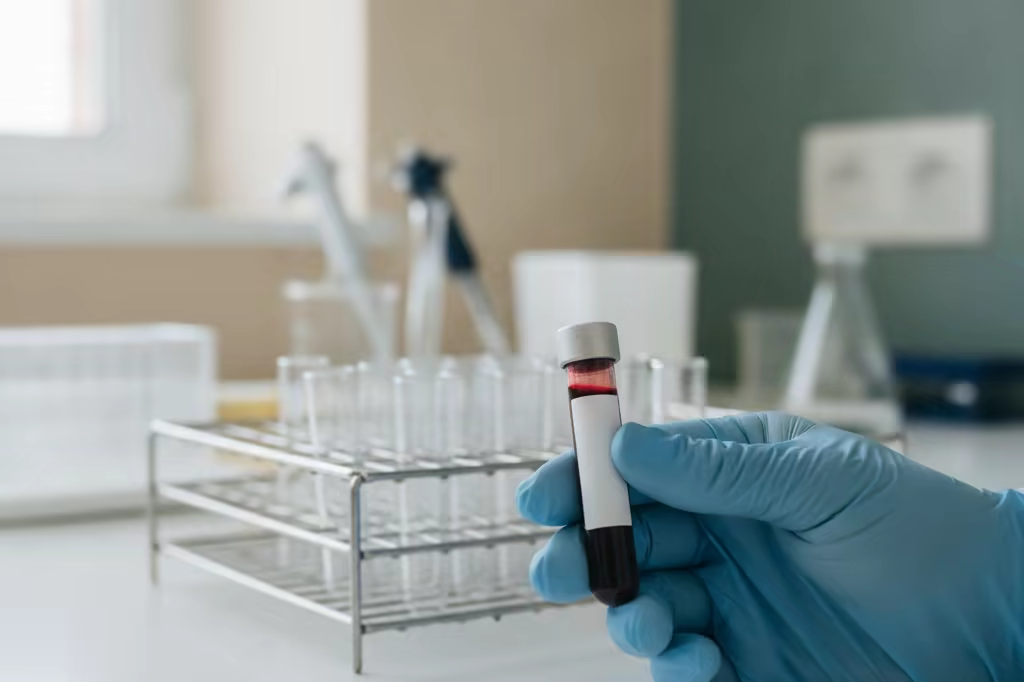
Different samples cover different spans of time. Blood and saliva answer "in the last few days." Urine is the most common screening sample. Hair and nails answer "over the last several months," which is why they are used for research and for disputed-history cases rather than for routine screening.
| Sample | What it reflects | What is measured |
|---|---|---|
| Blood | Exposure over the past 3 to 4 days | Cotinine concentration, reported in ng/mL |
| Saliva | Recent days, tracking blood levels closely | Cotinine |
| Urine | Recent days; the usual screening sample | Cotinine, often with other nicotine metabolites |
| Hair or nails | Months of cumulative exposure | Nicotine and cotinine deposited as the hair or nail grew |
| Exhaled breath | Hours, not days | Carbon monoxide from smoke — not nicotine at all |
Results are interpreted against a threshold rather than as present-or-absent. In the CDC's national surveillance data, adults with serum cotinine at or below 10 ng/mL who do not report current smoking are classified as nonsmokers — a cut-point set high enough that secondhand smoke exposure does not get misread as active smoking.
What makes nicotine clear faster or slower?
The rate-limiting step is the liver enzyme CYP2A6, which performs the first half of the conversion to cotinine. How active that enzyme is varies substantially between people, and that variation drives most of the differences in clearance:
- Genetics. CYP2A6 activity is inherited, and reduced-function variants are common. Slower metabolizers clear nicotine less quickly and tend to smoke fewer cigarettes for the same effect.
- Ancestry and population differences. Benowitz's group found Chinese-American participants had the lowest total and non-renal clearance of both nicotine and cotinine, and that slower cotinine metabolism partly explains the higher cotinine levels measured per cigarette in Black Americans than in white Americans.
- Menthol. Menthol inhibits nicotine metabolism, which contributes to that same pattern where mentholated products are more commonly used.
- Pregnancy. Nicotine and cotinine clearance both increase substantially during pregnancy.
- Liver function and age. Reduced hepatic blood flow with age, and impaired liver function generally, slow metabolism.
- How much and how often. Heavier, more frequent use produces higher cotinine concentrations to start from, so it takes longer to fall below a threshold.
Do vapes, pouches, and patches show up on a nicotine test?
Yes. Cotinine is produced from nicotine regardless of how the nicotine arrived. Vaping, nicotine pouches, chewing tobacco, lozenges, gum, and patches all produce cotinine, and a standard screen cannot distinguish them from smoking.
This surprises people in two directions. Someone who switched from cigarettes to vaping to pass an insurance screen will still test positive. And someone using a nicotine patch prescribed to help them quit will also test positive, which is why cessation programs and insurers usually ask about nicotine-replacement therapy up front rather than treating a positive result as a contradiction.
The one test that does distinguish is exhaled carbon monoxide, which comes from combustion. A vape or a pouch produces no carbon monoxide; a cigarette does. It measures smoking rather than nicotine.
Can you flush nicotine out of your system faster?
No. There is no way to meaningfully speed up nicotine or cotinine clearance, because the rate is set by enzyme activity rather than by how much fluid passes through you. Water, exercise, vitamin C, and detox products do not change CYP2A6 activity. Drinking large volumes of water before a urine test dilutes the sample, which many labs detect and flag as an invalid specimen rather than a negative result.
The only variable genuinely under your control is when you last used nicotine, and in what amount.
What happens after the nicotine is actually gone?
Nicotine clears in hours, but nicotine dependence does not. Withdrawal symptoms — irritability, difficulty concentrating, restlessness, increased appetite, low mood, and disrupted sleep — typically begin within hours of the last use, peak in the first few days, and ease over two to four weeks. Cravings can be triggered by cues long after the chemical is gone, which is the part that makes quitting hard rather than the chemistry.
That is also why cessation support works better than willpower alone. Cognitive behavioral therapy addresses the cue-and-response pattern directly, and medication options are broader than most people assume — our posts on naltrexone for smoking cessation and NAC look at two of them. Longer-term physical effects, including nicotine and hair loss, tend to be what finally motivates people who have ignored the headline risks for years.
When nicotine dependence sits alongside another substance — and it very often does — treating them separately rarely works. Nicotine use disorder treatment and outpatient care at Lantana address both in the same plan, and how nicotine affects the brain is worth understanding before you try to out-argue a craving.

The Bottom Line
Nicotine is mostly gone within half a day; cotinine, the thing being measured, lingers for several days and is what determines a test result. Nothing you drink or take shortens either timeline. If the reason you are counting hours is an insurance physical or a job screen, the honest calculation involves days rather than hours — and if it is because you want to stop, the chemistry is the easy part and the cravings are the part worth getting help with.
FAQ: Nicotine, Cotinine, and Test Results
How long does nicotine stay in your urine?
What is the half-life of nicotine?
Will vaping show up on a nicotine test?
Can you flush nicotine out of your system with water?
How long after quitting will a nicotine test be negative?
Does secondhand smoke make you test positive?

Sources
- Benowitz, Hukkanen & Jacob (2009), Handbook of Experimental Pharmacology — Nicotine chemistry, metabolism, kinetics and biomarkers: nicotine and cotinine half-lives, CYP2A6 as rate-limiting, and population differences in clearancehttps://pmc.ncbi.nlm.nih.gov/articles/PMC2953858/
- Centers for Disease Control and Prevention, MMWR — Exposure to Secondhand Smoke Among Nonsmokers, United States: serum cotinine classification of nonsmokers at or below 10 ng/mLhttps://www.cdc.gov/mmwr/volumes/67/wr/mm6748a3.htm

Reviewed by
Warren PhillipsCo-Founder, LMSW · Editorial Reviewer
Warren Phillips is a Co-Founder of Lantana Recovery and a Licensed Master Social Worker (LMSW) specializing in substance abuse and mental health treatment. He previously worked in various capacities at Turnbridge Addiction Treatment and Clearpoint Recovery Center before co-founding Lantana Recovery. Warren's clinical approach draws on a strengths-based perspective, Twelve Step philosophies, Cognitive Behavioral Therapy, and Motivational Interviewing. He brings both personal and professional experience to his work — as a person in long-term recovery from alcohol and illicit substances, he has used that experience to help shape Lantana's treatment programming. Warren grew up in Memphis, TN and St. Louis, MO, attended college in Mississippi, and lived in California and Connecticut before relocating to Charleston. He now lives in Mount Pleasant with his wife, Angela, and their two young children, Hall and Sam.
Written by the Lantana Recovery Editorial Team and reviewed for clinical accuracy before publication.