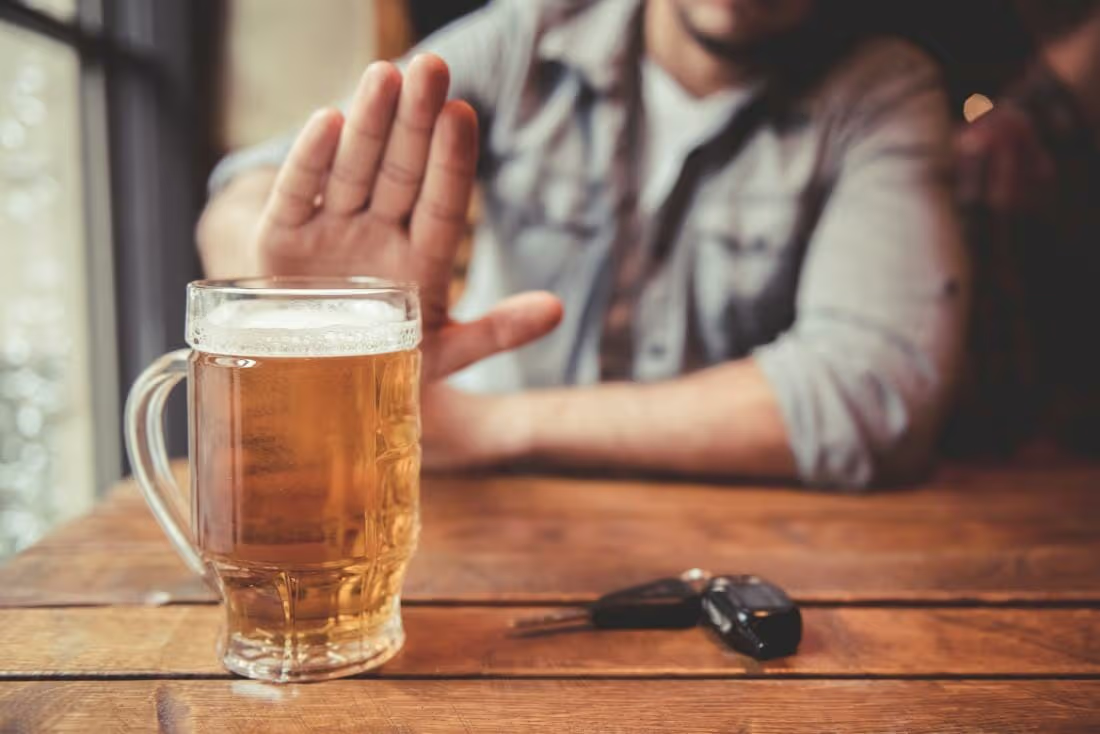
California sober means no alcohol or hard drugs while still using cannabis. Here is what the research shows about substitution, and who should be careful.
Jump to a section
California sober means giving up alcohol and hard drugs while continuing to use cannabis — and for some people, occasional psychedelics. It is a harm-reduction position rather than a clinical term, and it sits in the middle of a real disagreement about whether reducing harm counts as recovery. This article covers what the phrase actually means, where it came from, what the research shows about substituting cannabis for alcohol, who it appears to work for, and who has good reason to be cautious about it.
Key Takeaways on California Sober
- California sober generally means no alcohol and no hard drugs, with cannabis still allowed — definitions vary by the person using the term.
- It is not a clinical designation. No diagnostic manual or treatment protocol uses it.
- In a secondary analysis of the COMBINE trial, any cannabis use during alcohol treatment was associated with about 4 fewer alcohol-abstinent days by the end of treatment.
- For those who used cannabis once or twice a month during treatment, the gap was larger: roughly 10 fewer abstinent days at treatment end and 13 fewer a year later.
- Harm reduction is a legitimate, evidence-based framework. The honest question is not whether it counts as sober, but whether it works for the specific person trying it.
What does "California sober" actually mean?
The core definition is abstaining from alcohol and from what people generally mean by hard drugs — opioids, stimulants, benzodiazepines — while continuing to use cannabis. Beyond that, usage varies:
- Some people include occasional psychedelics; most do not.
- Some restrict cannabis to evenings, or to a specific form, or to a stated quantity; many set no limit at all.
- Some arrive at it as a deliberate long-term plan; others as a transitional step toward full abstinence.
That vagueness matters, because "I'm California sober" can describe a person who has stopped a life-threatening drinking pattern and uses cannabis twice a month, or a person who has replaced daily drinking with daily heavy cannabis use. Those are different situations with different outcomes, and the same phrase covers both.
Where did the term come from?
It circulated informally for years before entering mainstream use in 2021, when the singer Demi Lovato released a song by that name and discussed the approach publicly. The following year they publicly reversed course, stating that full abstinence was what worked for them.
That arc is worth noting without turning it into a parable. One person's experience is not evidence about anyone else's. What the episode did establish is that the phrase now carries cultural weight far beyond its precision, which is part of why it is worth defining carefully before using it about yourself.
Is California sober actually sober?
This is a definitional argument rather than a factual one, and both sides are consistent within their own framework.
In the abstinence-based tradition — which includes the 12 Steps — sobriety means no mood-altering substances, so the answer is no by definition. In a harm-reduction framework, the relevant measure is whether harm went down, and a person who stopped drinking a liter of vodka a day has achieved something substantial regardless of what label applies.
Both positions are defensible, and the argument between them is largely unwinnable because they are measuring different things. The more useful question is not which definition is correct but a practical one: is this working, for this person, over time?
What does the research say about substituting cannabis for alcohol?
The evidence is genuinely mixed at the population level — some studies find people use cannabis in place of alcohol, others find the two travel together — but the most directly relevant research asks a narrower question: what happens to people in treatment for alcohol use disorder who also use cannabis?
A secondary analysis of the COMBINE study, a randomized trial of alcohol use disorder treatments, compared 206 cannabis users with 999 cannabis abstainers among 1,383 participants with alcohol dependence. Any cannabis use during treatment was associated with 4.35% fewer alcohol-abstinent days — roughly four days — by the end of the 16-week treatment period.
The pattern within that is odd and worth stating precisely. The strongest association was not among the heaviest cannabis users but among those who used once or twice a month: about 10 fewer alcohol-abstinent days at treatment end and about 13 fewer a year post-treatment. A separate analysis found cannabis use during alcohol treatment associated with more alcohol-related problems one year afterward.
These are observational findings inside a trial, not proof that cannabis caused the extra drinking days — people who choose to use cannabis during treatment may differ in other ways. But the direction is consistent, and it is the opposite of what the substitution theory predicts. If cannabis reliably replaced alcohol, cannabis users in alcohol treatment should have drunk less. They did not.
Who does it seem to work for, and who should be careful?
Stated as honestly as the evidence allows, rather than as a recommendation either way.
It has a better chance of working for someone whose problem is specifically alcohol, whose cannabis use is genuinely occasional and stays that way, who has no history of cannabis use disorder, and who has a real plan for what happens if cannabis use starts escalating.
There are clearer reasons for caution:
- A history of cannabis use disorder. Cannabis is not a neutral substance for someone who has previously lost control of it.
- Psychosis risk. Personal or family history of psychotic illness is a well-established reason to avoid high-potency cannabis specifically.
- Using it to manage the same thing alcohol managed. If cannabis is doing the job alcohol did — sleep, anxiety, evenings — the behavior pattern has continued with a different substance in the slot.
- Escalation. Cannabis use that climbs steadily after alcohol stops is the clearest signal that the substitution is not holding.
- Active alcohol treatment. The COMBINE findings apply directly here, and are worth discussing with the clinician rather than around them.
What harm reduction actually means clinically
Harm reduction is not a euphemism for giving up on abstinence. It is a framework holding that reductions in harm are worth achieving on their own terms — fewer overdoses, fewer hospitalizations, fewer deaths — and that people who are not ready to stop entirely still deserve care.
In practice, most clinicians hold both ideas at once. Someone who has cut heavy daily drinking to a fraction has made a real gain even if the plan is not what an abstinence framework would prescribe, and treating that gain as failure is a reliable way to lose the person entirely. This maps onto where someone actually is in the stages of change: a partial step from someone in contemplation is not the same event as a partial step from someone in maintenance.
What harm reduction does not mean is skipping the honest accounting. "Is this working?" has checkable answers — how often, how much, what happened last month, what the people around you would say.
How to tell whether it is working
Six months in, the useful questions are concrete rather than philosophical:
- Is cannabis use higher than when you started, and has that increase been gradual enough not to notice?
- Has alcohol genuinely stayed out, or has it reappeared in specific situations?
- Are the things drinking damaged — sleep, work, relationships, money, health — actually recovering?
- Could you stop cannabis for a month without difficulty, and do you know that from experience or from assumption?
- Would the people closest to you describe the past six months the way you just did?
If those answers are good, that is meaningful information. If several are uncomfortable, that is also information, and it does not mean the attempt failed — it means the plan needs revising. Alcohol use disorder treatment and outpatient care at Lantana start from where someone actually is rather than from a required position, and if cannabis has become the problem rather than the workaround, cannabis use disorder treatment addresses that directly. Knowing what a bad reaction looks like — see our guide to greening out — is worth having too.

The Bottom Line
California sober is a harm-reduction position, not a clinical category, and whether it counts as sobriety depends on which framework you are standing in. The evidence that matters more than the label: among people in treatment for alcohol use disorder, cannabis use was associated with fewer alcohol-free days, not more — roughly four fewer by the end of treatment, and about 13 fewer a year later among once-or-twice-a-month users. That does not make it the wrong choice for everyone. It does mean the substitution should be measured rather than assumed, and that the honest check-in six months from now is worth more than the label you use today.
FAQ: Harm Reduction, Substitution, and Terminology
What does California sober mean?
Is California sober really sober?
Does cannabis help people drink less?
Where did the term California sober come from?
Who should avoid the California sober approach?
Is harm reduction the same as giving up on recovery?

Sources
- Subbaraman, Metrik, Patterson & Swift (2017), Addiction — Cannabis use during treatment for alcohol use disorders predicts alcohol treatment outcomes: secondary analysis of the COMBINE study, 206 cannabis users versus 999 abstainers among 1,383 participantshttps://pubmed.ncbi.nlm.nih.gov/27865015/
- Cannabis use during alcohol treatment is associated with alcohol-related problems one-year post-treatmenthttps://pmc.ncbi.nlm.nih.gov/articles/PMC6239961/
- National Institute on Alcohol Abuse and Alcoholism, Alcohol Research: Current Reviews — Patterns of Cannabis and Alcohol Co-Use: Substitution Versus Complementary Effectshttps://arcr.niaaa.nih.gov/niaaa-50th-anniversary-festschrift/patterns-cannabis-and-alcohol-co-use-substitution-versus

Reviewed by
Warren PhillipsCo-Founder, LMSW · Editorial Reviewer
Warren Phillips is a Co-Founder of Lantana Recovery and a Licensed Master Social Worker (LMSW) specializing in substance abuse and mental health treatment. He previously worked in various capacities at Turnbridge Addiction Treatment and Clearpoint Recovery Center before co-founding Lantana Recovery. Warren's clinical approach draws on a strengths-based perspective, Twelve Step philosophies, Cognitive Behavioral Therapy, and Motivational Interviewing. He brings both personal and professional experience to his work — as a person in long-term recovery from alcohol and illicit substances, he has used that experience to help shape Lantana's treatment programming. Warren grew up in Memphis, TN and St. Louis, MO, attended college in Mississippi, and lived in California and Connecticut before relocating to Charleston. He now lives in Mount Pleasant with his wife, Angela, and their two young children, Hall and Sam.
Written by the Lantana Recovery Editorial Team and reviewed for clinical accuracy before publication.